Device hub · VR / spatial · Desk research
ASUS HC102
HC102 is first-wave WMR at 1440×1440 / 90 Hz / 95° H.
Product images
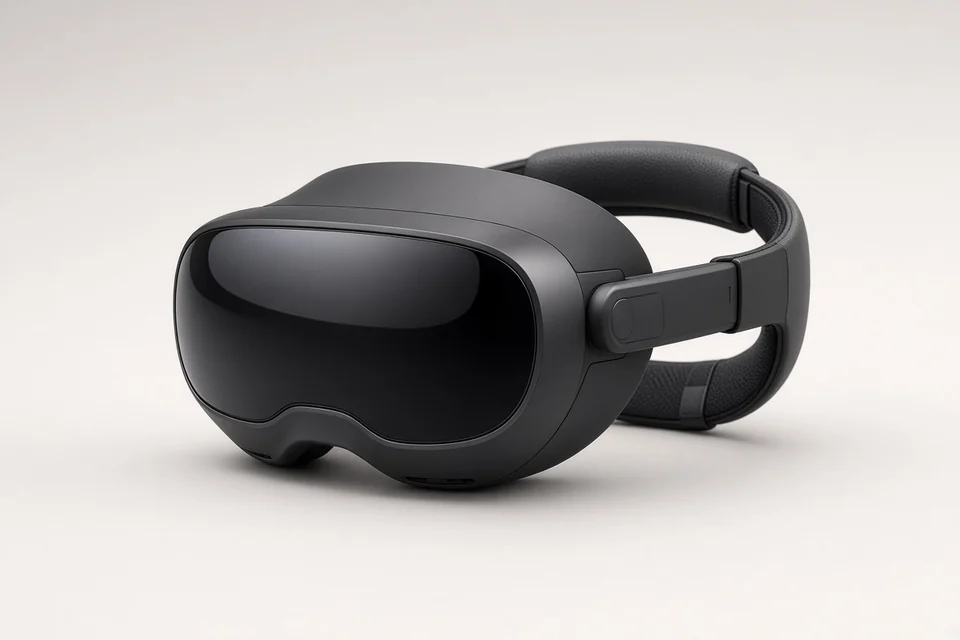 Placeholder — OEM press not licensed
ASUS Edge Up, the 2017 IFA press, and Microsoft’s WMR table remain the official sources. Product photos are not hosted.
Credit: GadgetShowdown labeled placeholder (not an ASUS asset). View official product image
Studio still only. Manufacturer press JPEGs are not hosted here. See the official product page for the real product photo.
In short
HC102 is first-wave WMR at 1440×1440 / 90 Hz / 95° H. Keep Edge Up 400 g and IFA “under 400 g.” Do not copy OJO 500’s 100° or AH101’s $399.99 here.
Who it is for
- Owners documenting HC102 from Microsoft’s WMR table plus ASUS Edge Up / IFA press.
- Writers comparing first-wave 95° ASUS to OJO 500’s 100° without mixing the slugs.
Who should skip it
- Windows 11 24H2+ PCs. Microsoft: WMR unsupported.
- Shoppers treating OJO 500’s 100° / 600 g or AH101’s $399.99 as this H1.
- People who need one official gram number. Edge Up 400 g vs IFA under 400 g.
- Standalone / no-PC buyers.
Key differentiators
- 2.89-inch LCD; 1440×1440 per eye; 90 Hz; 95° horizontal Fresnel-aspheric (Edge Up).
- Inside-out 6DoF; two cameras; flip-up visor (Edge Up).
- 2018 Edge Up MSRP $429; two wireless 6DoF controllers in that table.
Caveats
- Mass conflict: Edge Up table 400 g vs IFA press “under 400 g.” Flag both; do not average.
- asus.com US/IT product newsroom URLs were a maintenance shell this pass. Cite Edge Up + IFA press + Microsoft.
- Edge Up competitor-gram asides (Rift 470 g, Vive 555 g, PS VR 610 g) are not those hubs’ OEM cells — do not copy them backward.
- Launch $429 is 2018 MSRP. Do not print it as a 2026 street price.
- No hands-on testing.
VR-category specs
Same rows on every headset hub (Vision Pro, Quest, Galaxy XR, PICO, PS VR2). FOV, weight, and battery cells quote the manufacturer footnote — they are not lab measurements.
| Attribute | Value | Source / note |
|---|---|---|
| Display type | 2.89-inch LTPS LCD (Edge Up). Microsoft table: LCD | ASUS Edge Up HC102; Microsoft WMR table |
| Display resolution | 1440 × 1440 per eye (2880 × 1440 combined). Edge Up: 60% more pixels than Rift/VIVE — manufacturer arithmetic, not a lab score | ASUS Edge Up HC102; Microsoft WMR table |
| Refresh rate (OEM) | 90 Hz (Edge Up). Microsoft: up to 90 Hz | ASUS Edge Up HC102; Microsoft WMR table |
| Field of view (OEM claim) | 95° horizontal Fresnel-aspheric (Edge Up). Microsoft WMR table: 95°. Not OJO 500’s 100° | ASUS Edge Up HC102; Microsoft WMR table |
| Optics / lenses | Fresnel-aspheric (Edge Up). Flip-up hinged visor | ASUS Edge Up HC102 |
| Chip / processor | Not published | ASUS Edge Up HC102 |
| RAM / unified memory | Not a headset RAM SKU. PC RAM is the WMR/Ultra PC class of that era — not reprinted as GB on the Edge Up spec table | ASUS Edge Up HC102 |
| On-device storage | None (PC VR) | ASUS Edge Up HC102; Microsoft WMR table |
| Operating system | Windows Mixed Reality. Edge Up: Windows 10 version 1709 or later for that write-up. Microsoft later: WMR not supported on Windows 11 24H2 and newer | ASUS Edge Up HC102; Microsoft WMR FAQ |
| Tracking | Inside-out 6DoF; two black-and-white VGA cameras plus gyro / accelerometer / magnetometer / proximity (Edge Up). No external sensors | ASUS Edge Up HC102 |
| Controllers | Two wireless 6DoF controllers (Edge Up table). 32 LEDs each (Edge Up body). Microsoft: pair to the PC Bluetooth radio (headset Bluetooth none) | ASUS Edge Up HC102; Microsoft WMR table |
| Other input | Controller touchpad + analog stick + triggers + grip (Edge Up). No eye tracking on the cited pages | ASUS Edge Up HC102 |
| PC / console tether | Required. HDMI 2.0 + USB 3.0 (Edge Up). Not standalone | ASUS Edge Up HC102 |
| IPD | Software IPD (Microsoft WMR table). No mechanical slider on that table. Millimeter window not on Edge Up (accessed 2026-09-19) | Microsoft WMR table; ASUS Edge Up HC102Do not invent 63±8 mm from a locale newsroom that was a maintenance shell this pass. |
| Weight | Edge Up spec table: 400 g. IFA 2017 press: under 400 g. Flag both; do not average | ASUS Edge Up HC102; ASUS IFA 2017 press |
| Passthrough / see-through | Microsoft: WMR inside-out cameras are positional tracking only; headsets are occluded. Flip-up visor is a physical peek (Edge Up) | Microsoft WMR FAQ; ASUS Edge Up HC102 |
| Eye tracking | Not listed | ASUS Edge Up HC102; Microsoft WMR table |
| Battery — headset (OEM) | Tethered visor — no headset-hour row. Controllers are wireless (Edge Up) | ASUS Edge Up HC102 |
| Battery style | PC/wall tethered headset. Controller batteries not itemized as Wh on the cited table | ASUS Edge Up HC102 |
| Charging (OEM) | Headset powered from HDMI/USB. Controller charging not itemized on the Edge Up spec table | ASUS Edge Up HC102 |
| Audio | 3.5 mm jack only (Edge Up; Microsoft). Bring your own headphones (Edge Up) | ASUS Edge Up HC102; Microsoft WMR table |
| Wireless | Headset is a wired HDMI/USB visor. Microsoft: Bluetooth none on the headset row — controllers pair to the PC | Microsoft WMR table; ASUS Edge Up HC102 |
| Glasses / prescription | Microsoft WMR FAQ (platform): you can wear a WMR headset with or without glasses. No HC102-specific glasses checkbox on Edge Up | Microsoft WMR FAQ; ASUS Edge Up HC102 |
| Platform / account lock | Windows Mixed Reality + SteamVR via the WMR for SteamVR client (Edge Up). Not Meta Quest Store | ASUS Edge Up HC102 |
| Age / intended use (OEM) | Not stated as a minimum age on the cited Edge Up / IFA / Microsoft pages (accessed 2026-09-19) | Cited ASUS / Microsoft pages |
| US list price (dated) | $429 USD MSRP (ASUS Edge Up, 28 February 2018), ASUS Store and B&H in that table. 2026 street not captured. Live asus.com newsroom was a maintenance shell | https://edgeup.asus.com/2018/escape-inside-the-asus-hc102-windows-mixed-reality-headset/ |
| Price band | Legacy first-wave WMR (2018 $429) | ASUS Edge Up HC102 |
| Announced / introduced | IFA press 30 August 2017 (unnamed “ASUS Windows Mixed Reality Headset”). Edge Up / US availability narrative February 2018 as HC102 | ASUS IFA 2017 press; ASUS Edge Up 2018-02-28 |
| Availability | Legacy leftover / used-market. Microsoft: WMR headsets no longer manufactured or sold; unsupported on Windows 11 24H2+ | Microsoft WMR FAQ |
ASUS HC102 extras
Unique to this line or SKU. Other headsets keep the first table aligned and swap this extras list.
| Attribute | Value | Source / note |
|---|---|---|
| Mass conflict | Edge Up table 400 g vs IFA press under 400 g. Do not average | ASUS Edge Up; ASUS IFA 2017 press |
| vs OJO 500 | OJO 500 is 100° / mechanical IPD / 600 g DE SKU. This H1 stays 95° / software IPD / 400 g or under 400 g | /vr/acer-ojo-500/; this table |
| Competitor grams on Edge Up | Edge Up aside prints Rift 470 g, Vive 555 g, PS VR 610 g. Those are not the OEM cells on /vr/oculus-rift/, /vr/htc-vive/, or /vr/playstation-vr/ — do not copy them backward | ASUS Edge Up HC102 |
Overview
HC102 stays a hub so first-wave WMR 95° is not flattened onto OJO 500. WMR peers: /vr/dell-visor/, /vr/acer-ojo-500/, /vr/hp-reverb/.
Mass conflict (do not average)
| ASUS document | Headset mass |
|---|---|
| Edge Up spec table (2018-02-28) | 400 g |
| IFA 2017 press | Under 400 g |
Quote the URL. Do not invent 390 g.
Display and FOV
1440 × 1440 per eye, 90 Hz, 95° horizontal Fresnel-aspheric. Microsoft’s table is a bare 95°. Keep the axis when you quote Edge Up.
Sources
- ASUS Edge Up — HC102 (1440×1440, 95° H, 400 g, $429) — accessed 2026-09-19
- ASUS Pressroom — IFA 2017 (“under 400 g”) — accessed 2026-09-19
- Microsoft — WMR before-you-buy table (95°, software IPD, BT none) — accessed 2026-09-19
- ASUS US newsroom HC102 announce (maintenance shell this pass) — accessed 2026-09-19
Frequently asked questions
Is this Acer OJO 500?
No. OJO 500 is /vr/acer-ojo-500/ (100°, mechanical IPD). This hub is ASUS HC102 at 95° H / software IPD.
400 g or under 400 g?
ASUS Edge Up prints 400 g. The IFA 2017 press says under 400 g. We keep both.
Does it work on Windows 11 24H2?
Microsoft: Windows Mixed Reality is not supported on Windows 11 version 24H2 and newer.
Official product page: ASUS HC102. Specs: ASUS HC102 specs.