 Get Meta Quest 3 over the cheaper Quest 3S for sharper 2064 × 2208 panels, pancake lenses and a wider 110-degree field of view; both use the XR2 Gen 2 chip.
1 / 6
Meta Quest, Sony’s PlayStation headset, Galaxy XR, HTC VIVE and Pimax. The first thing to know about any headset is what it plugs into, if anything, so each guide starts there, then covers the screens, tracking and price.
Get Meta Quest 3 over the cheaper Quest 3S for sharper 2064 × 2208 panels, pancake lenses and a wider 110-degree field of view; both use the XR2 Gen 2 chip.1 / 6
 Get Meta Quest 3S for Quest 3's chip and color passthrough for less, from $349.99; it saves money with Fresnel lenses and Quest 2's 1832 × 1920 resolution.
2 / 6
 PlayStation VR2 needs a PS5, or a capable Windows PC and Sony's adapter: it's a wired OLED headset with eye tracking and Sense controllers in the box.
3 / 6
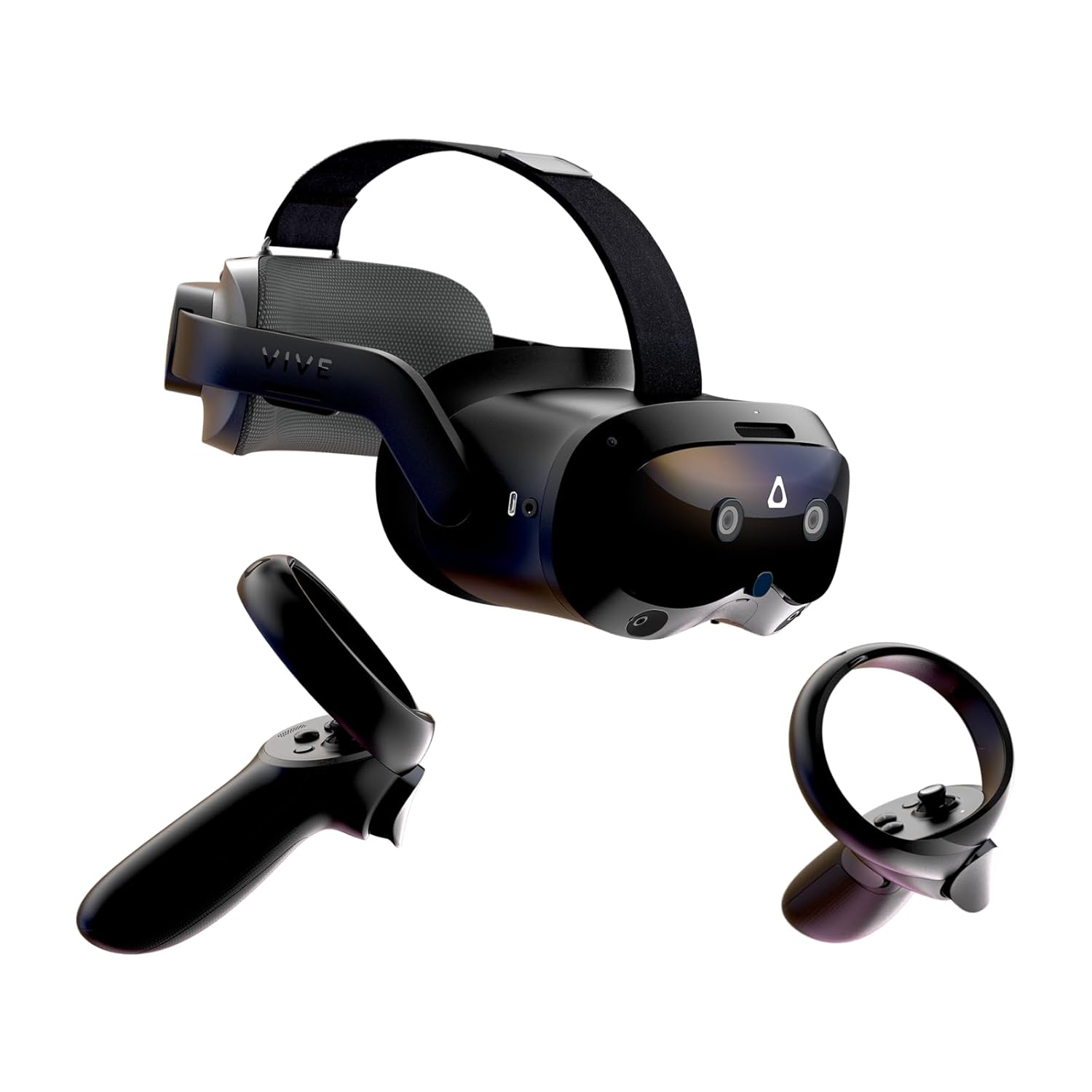 Get HTC VIVE Focus Vision if you want one headset for standalone and PC VR, with eye tracking, a swappable battery and no base stations.
4 / 6
 Pimax Crystal Super needs a Windows PC with a strong graphics card and DisplayPort; it's a wired headset with 3840 × 3840 pixels per eye and eye tracking.
5 / 6
 Samsung Galaxy XR is a standalone Android XR headset with Gemini: no PC needed, just a Samsung or Google account for apps.
6 / 6
Photos from Amazon listings and Wikimedia Commons.
Pimax Crystal Super needs a Windows PC with a strong graphics card and DisplayPort; it's a wired headset with 3840 × 3840 pixels per eye and eye tracking.
Samsung Galaxy XR is a standalone Android XR headset with Gemini: no PC needed, just a Samsung or Google account for apps.
Get HTC VIVE Focus Vision if you want one headset for standalone and PC VR, with eye tracking, a swappable battery and no base stations.
Get Meta Quest 3S for Quest 3's chip and color passthrough for less, from $349.99; it saves money with Fresnel lenses and Quest 2's 1832 × 1920 resolution.
Get Pimax Crystal Light for very sharp wired PC VR at $899: 2880 × 2880 pixels per eye and 35 pixels per degree, tracked by its own cameras.
Get Meta Quest 3 over the cheaper Quest 3S for sharper 2064 × 2208 panels, pancake lenses and a wider 110-degree field of view; both use the XR2 Gen 2 chip.
PlayStation VR2 needs a PS5, or a capable Windows PC and Sony's adapter: it's a wired OLED headset with eye tracking and Sense controllers in the box.
The original Quest has OLED screens, Snapdragon 835 and 72 Hz; Quest 2 moves to a Fast-Switch LCD with more pixels, XR2 Gen 1, 6 GB and refresh up to 120 Hz.
Quest 2 is Meta's 2020 headset, no longer sold new, with grayscale passthrough and XR2 Gen 1; Quest 3 adds color passthrough, a depth sensor, XR2 Gen 2 and sharper 2064 × 2208 panels.
Quest 3S keeps Quest 2's 1832 × 1920 resolution but moves to XR2 Gen 2, 8 GB and full-color passthrough; Meta no longer sells Quest 2.
Quest 3 and Quest 3S share the XR2 Gen 2 chip, 8 GB of memory and color passthrough; Quest 3 adds sharper 2064 × 2208 screens, pancake lenses, a 110° view and a depth sensor.
Quest 3 is a standalone headset with color passthrough; PlayStation VR2 is Sony's OLED headset with eye tracking that runs from a PS5, at a $549.99 launch price.
Quest 3 is Meta's game headset, usually sold with controllers and tied to the Quest Store; Galaxy XR is Samsung's $1,799.99 Android XR headset, with sharper Micro-OLED panels and eye tracking but controllers extra.
Crystal Light is Pimax's $899 PC headset with 2880 × 2880 panels and a 120Hz mode but no eye tracking; Crystal Super has 3840 × 3840 panels, eye tracking, automatic IPD and swappable optics for $1,599 to $1,799.


