Fitness watches comparison · Maker specs
Apple Watch SE 3 vs Apple Watch Series 12
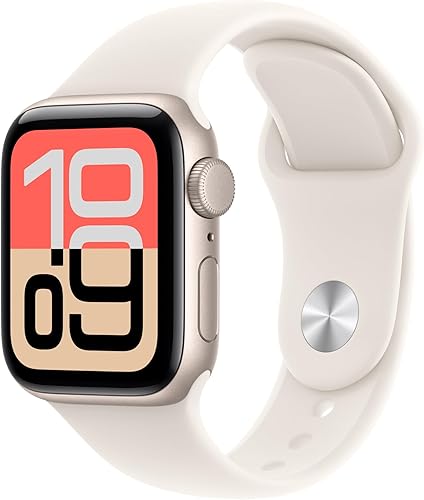

Quick Answer
Buy Apple Watch Series 12 for ECG, Blood Oxygen and the new heart sensors; at $399 it also brings a brighter screen and a 24-hour battery. Buy Apple Watch SE 3 at $249 if you mainly want notifications, workouts and sleep tracking on an Always-On screen. Both get watchOS 27.
The verdict
Apple Watch SE 3 covers the basics for less; Apple Watch Series 12 is worth the extra $150 if you'll use ECG, Blood Oxygen and the new heart sensors.
Why: Both are current, both get watchOS 27, and both have Always-On screens, 64GB, a Sleep score, sleep apnea notifications, Crash Detection and Fall Detection. Series 12 adds the S11 chip and the Health Sensing System, with ECG, Blood Oxygen and readiness, plus a 2,000-nit screen against 1,000, a thinner 9.7mm case, and up to 24 hours of battery against 18.
Buy Apple Watch SE 3 if
You want an Always-On watch for notifications, workouts and sleep tracking, and you'd rather keep the $150.
Buy Apple Watch Series 12 if
You'd use ECG, Blood Oxygen or the readiness score, or you want a bigger, brighter screen and six more hours of rated battery.
Apple didn’t retire SE 3 when Series 12 arrived. SE 3 went on sale on 19 September 2025 and Series 12 on 18 September 2026, and they now sit $150 apart in the same lineup, with Ultra 4 above them. Both need an iPhone, and they have more in common than that price gap suggests.
Side by side
| Spec | Apple Watch SE 3 | Apple Watch Series 12 |
|---|---|---|
| Announced | 9 September 2025 | 9 September 2026 |
| Sizes | 40mm or 44mm aluminum | 42mm or 46mm aluminum, titanium or ceramic |
| Thickness | 10.7mm | 9.7mm in aluminum and titanium |
| Display | Always-On LTPO OLED, 1,000 nits, 2-nit minimum | Always-On wide-angle LTPO3, 2,000 nits, 1-nit minimum |
| Resolution | 324 × 394 or 368 × 448 | 374 × 446 or 416 × 496 |
| Chip and storage | S10; 64GB | S11; 64GB |
| Heart sensors | Second-generation optical | Health Sensing System |
| ECG and Blood Oxygen | No | Yes |
| Normal use | Up to 18 hours | Up to 24 hours |
| Low Power Mode | Up to 32 hours | Up to 38 hours |
| Outdoor workout | No separate rating | Up to 10 hours |
| Charge to 80% | About 45 minutes | About 30 minutes |
| GPS | L1 | Precision L1 |
| Water | 50m | 50m; snorkeling to 6m |
| Dust | Not published | IP6X |
| US launch price | $249 | $399 |
What the extra $150 buys: the health sensors
Series 12’s Health Sensing System combines a second-generation electrical heart sensor with an always-on optical sensor, blood oxygen and temperature sensing. Apple says it checks your heart rate in the background every five seconds and measures heart rate variability much more often than the previous Series. Only Series 12 has readiness, a daily score from 0 to 10, along with ECG, Blood Oxygen and hypertension notifications.
SE 3 has a second-generation optical sensor with high and low heart rate alerts and irregular rhythm notifications. Without an electrical sensor there’s no ECG; Apple has kept SE models out of the ECG app since Series 4. There’s no Blood Oxygen app either.
S11 also brings Audio Intelligence to Series 12, including Live Rewind and Siri Recap, which Apple calls late-2026 betas. SE 3 gets Siri AI but not Audio Intelligence. Both chips pair a 64-bit dual-core processor with a 4-core Neural Engine and 64GB, so storage isn’t part of the upgrade.
Sleep tracking is close to a tie
Both have the Sleep app with sleep stages and a Sleep score, and both offer sleep apnea notifications in the regions Apple supports. On SE 3 they’re for people 18 and older, as on Series 9 or later and Ultra 2 or later, and they flag signs of moderate to severe sleep apnea rather than diagnosing it. If sleep is what you mostly want to track, SE 3 gives up very little.
A bigger, brighter screen in a thinner case
Series 12 is a millimeter thinner, 9.7mm against 10.7mm in aluminum and titanium, and comes in larger sizes: 42mm (42 × 37mm) and 46mm (46 × 40mm), with 970 and 1,196 square millimeters of screen against SE 3’s 759 and 977. Its wide-angle LTPO3 panel reaches 2,000 nits, twice SE 3’s peak, and dims to 1 nit. Ceramic cases measure about a millimeter larger than the aluminum ones of the same size.
SE 3 comes in 40mm (40 × 34 × 10.7mm, 324 × 394 pixels) and 44mm (44 × 38 × 10.7mm, 368 × 448), both at 326 ppi, in starlight or midnight aluminum that Apple says is 100 percent recycled. It peaks at 1,000 nits and dims to 2. A 40mm GPS model weighs 26.3 grams and a 44mm 32.9 grams, with cellular versions a fraction heavier. Wrist fit runs from 130 to 200mm on the 40mm and 140 to 245mm on the 44mm.
Series 12 also offers far more finishes: dark bronze, black, light gold and space gray aluminum; radiant gold and natural titanium; and pearl white and night blue ceramic, with Hermès sold as a separate collection. Titanium and ceramic cost more than the $399 aluminum GPS model. A 46mm aluminum GPS Series 12 weighs 39.5 grams, and Apple lists the GPS aluminum models as heavier than the cellular ones.
Battery and charging
SE 3 is rated for up to 18 hours of normal use (Apple’s test includes a 60-minute workout) or 32 in Low Power Mode, with no separate outdoor workout rating. Its fast charger reaches 80% in about 45 minutes; 15 minutes gives about 8 hours of normal use and 8 minutes about 8 hours of sleep tracking.
Series 12 runs up to 24 hours, 38 in Low Power Mode and 10 in an outdoor workout. It also charges faster: 80% in about 30 minutes, about 12 hours of use from 15 minutes, and about 10 hours of sleep tracking from 5 minutes.
GPS, water and the outdoors
Both use single-frequency L1 GPS with GLONASS, Galileo, QZSS and BeiDou (Apple calls Series 12’s version precision L1), so neither has the Ultra’s dual-frequency GPS. Both are water resistant to 50 meters, but only Series 12 adds a depth gauge for snorkeling to 6 meters and a water temperature sensor. Series 12 is IP6X dust resistant; Apple hasn’t published a dust rating for SE 3, and it rates SE 3 for 0 to 35 degrees Celsius and altitudes up to 3,000 meters, with no cold-weather rating like the Ultra’s.
The workout lists are nearly identical, covering swimming, cycling, hiking and running as well as skiing, rowing and golf. SE 3 has offline maps, U.S. topographic maps, curated hikes in 63 national parks and Backtrack, along with Crash Detection, Fall Detection, noise monitoring, Emergency SOS and double tap. Running power is missing from its running metrics.
Wireless
Series 12 has Wi-Fi 4 on both 2.4GHz and 5GHz plus a second-generation ultra-wideband chip; SE 3 lists only 2.4GHz Wi-Fi and no ultra-wideband. Both have Bluetooth 5.3, and the cellular versions (A3326 and A3328 for SE 3, A3582 and A3587 for Series 12) use 5G RedCap and LTE. A cellular model of either can be set up for a child with Apple Watch For Your Kids, with some features held back.
Price
SE 3 starts at $249 and Series 12 at $399 for aluminum with GPS; titanium, ceramic and cellular models cost more, and education pricing can bring SE 3 lower. The $150 gap pays for the health sensors, the bigger and brighter screen and the longer battery, and apple.com has today’s prices, so check there before you buy. If you need a 49mm dive watch, neither fits: that’s Ultra 4, from $799.
Frequently asked questions
Does SE 3 have a temperature sensor?
Yes. SE 3 has a wrist temperature sensor, which Apple says isn't for medical use. Series 12 uses temperature sensing for Vitals and cycle tracking as part of its Health Sensing System. Having the sensor doesn't give SE 3 ECG or Blood Oxygen.
Is the SE 3 display Always-On?
Yes. It stays on with your wrist down, peaking at 1,000 nits and dimming to 2. Series 12 is Always-On too, on a wide-angle LTPO3 screen that reaches 2,000 nits and dims to 1. It's the previous SE that lacks Always-On.
Does SE 3 show running power?
No. It tracks custom workouts, training load, heart rate zones, Race Route, Pacer, stride length, ground contact time and vertical oscillation, but not running power, which Apple lists for its Ultra watches.
What glass does each watch use?
Ion-X on SE 3, which Apple says is four times more crack resistant than on SE 2. Aluminum Series 12 models use Ceramic Shield 2, which Apple calls 60 percent tougher than the Ion-X on Series 11, and titanium and ceramic models use sapphire. There's no sapphire SE 3.
Sources
- Apple Support — Apple Watch SE 3 tech specs — accessed 2026-09-22
- Apple Newsroom — Apple Watch SE 3 — accessed 2026-09-22
- Apple — Apple Watch Series 12 technical specifications — accessed 2026-09-22
- Apple Newsroom — Apple Watch Series 12, 9 September 2026 — accessed 2026-09-22