Fitness watches comparison · Maker specs
Apple Watch SE 3 vs Apple Watch Ultra 4
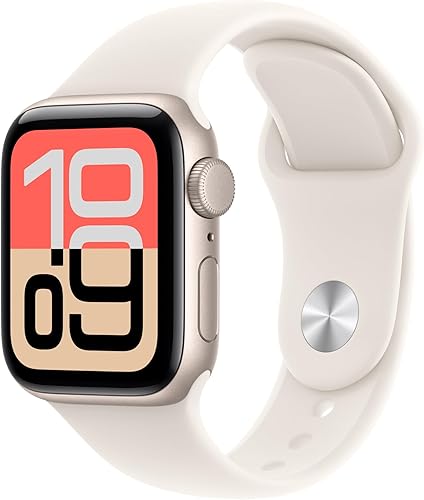

Quick Answer
Buy Apple Watch SE 3 at $249 if you want an Always-On watch that gets watchOS 27 and you're happy to charge it nightly. Pay $799 for Apple Watch Ultra 4 only if you need what it adds: up to 50 hours of battery, satellite messaging, a 40m dive rating, ECG and the new heart sensors. Want ECG in a smaller case? Series 12 starts at $399.
The verdict
Apple Watch SE 3 is the sensible everyday buy; Apple Watch Ultra 4 earns its price only if you'll use its battery, safety and dive hardware.
Why: Both get watchOS 27, and they share an Always-On screen, 64GB, sleep apnea notifications, Crash Detection and offline U.S. topographic maps. Ultra 4 adds S11 and the Health Sensing System, ECG and Blood Oxygen, a 3,000-nit screen, dual-frequency GPS, satellite, a 40m dive rating and up to 50 hours of battery against 18.
Buy Apple Watch SE 3 if
You want an everyday watch for notifications, workouts and sleep tracking, and charging it every night is fine.
Buy Apple Watch Ultra 4 if
You spend long days outdoors, dive, or go where there's no cell signal, or you want ECG and a battery that lasts two days.
These two bracket Apple’s current lineup, and SE 3 is a year older: Apple announced it on 9 September 2025, with stores from 19 September 2025, and Ultra 4 on 9 September 2026, in stores from 18 September 2026. Ultra 4 costs more than three times as much, and most of that money goes into hardware for long days outside.
What separates them
| Spec | Apple Watch SE 3 | Apple Watch Ultra 4 |
|---|---|---|
| Sizes | 40mm or 44mm | 49mm only |
| Case | Recycled aluminum, 10.7mm thick | Grade 5 titanium, 12mm thick |
| Display | Always-On, 1,000 nits, 2-nit minimum | Always-On LTPO3, 3,000 nits, 1-nit minimum |
| Chip and storage | S10; 64GB | S11; 64GB |
| Normal use | Up to 18 hours | Up to 50 hours |
| Low Power Mode | Up to 32 hours | Up to 84 hours |
| GPS workouts | No separate rating | 18, 25 or 45 hours, by mode |
| GPS | L1 | Dual-frequency |
| ECG and Blood Oxygen | No | Yes, where available |
| Water | 50m, swimming | 100m; dives to 40m |
| Satellite | No | SOS, Messages, Find My |
| Dust and durability | Not published | IP6X; MIL-STD-810H tested |
| US launch price | $249 | $799 |
Battery is the everyday difference
SE 3 is a charge-every-night watch: Apple rates it for 18 hours, or 32 in Low Power Mode, and gives it no GPS workout rating. Ultra 4’s ratings are nearly three times as long: up to 50 hours, 84 in Low Power Mode, and 18, 25 or 45 hours across its three GPS workout modes. The 45-hour Max Extended Workout covers outdoor running, walking and hiking with GPS checking your position every second.
Both reach 80% in about 45 minutes, but a short charge goes much further on Ultra 4: 15 minutes buys about 18 hours of normal use, against about 8 hours on SE 3. On SE 3, 8 minutes on the charger is good for about 8 hours of sleep tracking.
Only Ultra 4 has ECG and the new heart sensors
Ultra 4’s S11 runs the Health Sensing System. It checks your heart rate in the background every five seconds and gives you a readiness score from 0 to 10 each day. It also has ECG and Blood Oxygen, both limited by region and neither a diagnosis.
SE 3 relies on a second-generation optical heart sensor with high, low and irregular rhythm alerts. It has no electrical sensor, so no ECG: Apple’s ECG app covers Series 4 and later but never an SE. It also goes without Blood Oxygen, readiness, hypertension notifications and Audio Intelligence. What it does have is sleep stages, a Sleep score, sleep apnea notifications under Apple’s age and region rules, and a wrist temperature sensor that Apple says isn’t for medical use.
The outdoor gear is Ultra-only
Ultra 4’s titanium case measures 49 × 44 × 12mm, fits wrists from 130 to 210mm and weighs 63.0 grams in natural titanium or 63.1 in black. Its LTPO3 screen has 422 × 514 pixels and runs from 3,000 nits down to 1. Around it you get dual-frequency GPS, water resistance to 100 meters with EN 13319 certification for dives to 40 meters, a siren, an Action Button, and Emergency SOS, Messages and Find My over satellite. It’s IP6X dust resistant and tested to MIL-STD-810H, and Apple rates it for wrist temperatures as low as minus 20 degrees Celsius and altitudes up to 9,000 meters.
SE 3 has none of that. It uses single-frequency L1 GPS, drawing on GLONASS, Galileo, QZSS and BeiDou. It’s rated to 50 meters for shallow-water swimming, not diving, has no water temperature sensor and no IP6X or MIL-STD rating, and is rated for 0 to 35 degrees Celsius at altitudes up to 3,000 meters.
Where SE 3 keeps up
SE 3’s Always-On LTPO OLED sits under Ion-X glass, with 324 × 394 or 368 × 448 pixels at 326 ppi, running from 1,000 nits down to 2. The aluminum case is 10.7mm thick in starlight or midnight; a 40mm GPS model weighs 26.3 grams and a 44mm one 32.9, and they fit wrists from 130 to 200mm and 140 to 245mm.
Its S10 has the same 64GB as Ultra 4’s S11. Double tap, wrist flick and on-device Siri are there, and so are Crash Detection, Fall Detection, Backtrack, noise monitoring and Emergency SOS. The maps may surprise you: SE 3 has offline maps, U.S. topographic maps and curated hikes in all 63 U.S. national parks, so you don’t need an Ultra to follow a trail. You’d buy the Ultra for dual-frequency GPS, the siren and the hours.
Workouts overlap more than the price suggests. Both track running, hiking, cycling and swimming, plus skiing, rowing, paddling and golf. SE 3 handles custom pool workouts, stroke counts and SWOLF, and works with Bluetooth cycling accessories and Functional Threshold Power. It doesn’t show running power or water temperature; Ultra 4 adds both, plus Precision Start on the Action Button and a dive computer.
Phones, bands and the box
SE 3 needs an iPhone 11 or later; it launched requiring iOS 26 or later, and watchOS 27 needs iOS 27. Its cellular models, A3326 and A3328, support 5G RedCap and LTE, and its Wi-Fi 4 runs on 2.4GHz only, with no ultra-wideband chip. Apple Pay and GymKit work on both watches with a participating bank.
Bands don’t cross over: SE 3 uses the standard Apple Watch fitting, and Ultra 4 uses the Ultra fitting, with the Trail Loop, Alpine Loop and Ocean Band as its 2026 sport bands. Each box holds the watch, one band and a USB-C magnetic charger. Apple puts SE 3’s recycled content at 40 percent, including 100 percent recycled aluminum in the case, and Ultra 4’s at 45 percent, including 100 percent recycled titanium.
Price
SE 3 starts at $249, and education pricing has shown it at $229. Ultra 4 starts at $799. Between them sits Series 12 at $399, the one to look at if you want ECG and the Health Sensing System without a 49mm case. Launch prices aren’t sale prices, so check apple.com before you buy.
Frequently asked questions
How crack-resistant is the SE 3 glass?
Four times more than the previous SE's, according to Apple. That claim compares SE 3's Ion-X front with SE 2's, not with the flat sapphire crystal on Ultra 4, which doesn't use Ion-X.
Does SE 3 get sleep apnea notifications?
Yes, for people 18 and older in the countries where Apple offers the feature, which also runs on Series 9 or later and Ultra 2 or later. An alert points to signs of moderate to severe sleep apnea; it isn't a diagnosis. Ultra 4 has the same feature, with the same regional limits.
How long does SE 3 last in Low Power Mode?
Up to 32 hours, against 18 hours of normal use. Ultra 4 is rated for 84 hours in Low Power Mode and 50 in normal use, and it adds GPS workout ratings of 18, 25 and 45 hours that SE 3 doesn't have.
Can SE 3 be set up for a child?
Yes, if it's a cellular model. Apple Watch For Your Kids works on cellular SE 3 models, though not every feature is available, and the adult managing it still needs their own iPhone. Ultra 4 supports it as well.
Sources
- Apple Support — Apple Watch SE 3 tech specs — accessed 2026-09-22
- Apple — Apple Watch Ultra 4 tech specs — accessed 2026-09-22