Phones comparison · Maker specs
iPhone 17 Pro vs iPhone 16 Pro

Quick Answer
Buy iPhone 17 Pro for a brighter outdoor screen, longer battery life and the 48MP telephoto; keep iPhone 16 Pro if its titanium frame and 5x lens suit you. They launched a year apart at $1,099 and $999, and iPhone 18 Pro has since replaced both, so a discounted 17 Pro or a cheaper 16 Pro is the real choice. USB-C, Camera Control and the 6.3-inch ProMotion screen are on both.
The verdict
Get iPhone 17 Pro if you'll use the brighter screen, the longer battery rating and the 48MP telephoto; stay with iPhone 16 Pro if titanium and the 120 mm 5x lens already cover how you shoot.
Why: Same 6.3-inch 2622 × 1206 ProMotion screen, same 48MP main and ultrawide cameras, same USB-C, Camera Control and Action button. iPhone 17 Pro moves to an aluminum unibody and A19 Pro, raises the outdoor peak from 2,000 to 3,000 nits, plays video for six more hours (33 against 27), reaches 50 percent in 20 minutes on a 40W adapter, and trades the 12MP 5x telephoto for a 48MP 4x one.
Buy iPhone 17 Pro if
You're coming from an older iPhone or a tired 16 Pro, you're often out in bright sun, or you want the longer battery life, faster charging and the 18MP Center Stage front camera.
Buy iPhone 16 Pro if
You already own one and it still does the job, you prefer titanium, you often shoot at 120 mm, or a 128GB model at a low price is all you need.
Apple announced iPhone 16 Pro on 9 September 2024 and iPhone 17 Pro on 9 September 2025, both as the smaller of its two Pros. iPhone 18 Pro has since replaced both as the current model. That leaves two kinds of buyer here: 16 Pro owners wondering whether a 17 Pro is worth the swap, and anyone choosing between the two used, refurbished or discounted.
From the front they’re hard to tell apart. Both have a 6.3-inch Super Retina XDR screen at 2622 × 1206 and 460 pixels per inch, with ProMotion and an always-on display. The changes are in outdoor brightness, the frame, the chip, the telephoto, battery life, charging and price.
What changed and what didn’t
| Spec | iPhone 17 Pro | iPhone 16 Pro |
|---|---|---|
| Announced | 2025 | 2024 |
| US launch | $1,099 | $999 |
| Storage | 256GB, 512GB, 1TB | 128GB, 256GB, 512GB, 1TB |
| Frame | Aluminum unibody; Ceramic Shield 2 front; Ceramic Shield back | Titanium; Ceramic Shield front; textured matte glass back |
| Outdoor peak | 3000 nits | 2000 nits |
| Telephoto | 48MP, 100 mm, f/2.8, 4x; 12MP optical-quality 8x at 200 mm | 12MP, 120 mm, f/2.8, 5x tetraprism |
| Front camera | 18MP Center Stage, f/1.9 | 12MP TrueDepth, f/1.9 |
| Video playback | Up to 33 hours; 30 hours streamed | Up to 27 hours; 22 hours streamed |
| Audio playback | Not published | Up to 85 hours |
| Wired charging | Up to 50% in 20 minutes with 40W or higher | Up to 50% in around 30 minutes with 20W or higher |
| Qi2 | Up to 25W | Up to 15W |
| MagSafe | Up to 25W | Up to 25W with a 30W adapter or higher |
| Size and weight | 150.0 × 71.9 × 8.75 mm; 206 g | 149.6 × 71.5 × 8.25 mm; 199 g |
| Chip | A19 Pro, 6-core GPU, Neural Accelerators | A18 Pro, 6-core GPU |
| Radios | Apple N1; Wi-Fi 7; Bluetooth 6 | Wi-Fi 7; Bluetooth 5.3 |
| Display | 6.3-inch, 2622 × 1206, 460 ppi, ProMotion | Same |
| RAM and battery capacity | Not published | Not published |
Brighter outdoors, otherwise the same screen
The resolution didn’t move, but the outdoor peak did: 3,000 nits on iPhone 17 Pro against 2,000 on iPhone 16 Pro. Everything else about brightness matches, with 1,000 nits typical, 1,600 nits for HDR, a 1-nit minimum and a 2,000,000:1 typical contrast ratio on both. So the gain is in direct sun, not in everyday use. iPhone 17 Pro also adds an anti-reflective coating alongside the oleophobic coating both phones have.
A different telephoto, not just more zoom
iPhone 16 Pro’s telephoto is a 12MP tetraprism at 120 mm and f/2.8 with 3D sensor-shift optical image stabilization: a true 5x. Its zoom runs 5x optical in, 2x optical out, a 10x optical range, and up to 25x digital.
iPhone 17 Pro’s is a 48MP Fusion tetraprism at 100 mm and f/2.8, which Apple calls 4x, and it gives a 12MP optical-quality 8x crop at 200 mm. Its range runs 8x optical-quality in, 2x optical out, a 16x optical-quality range, and up to 40x digital.
So the longest real optical lens here is still the 2024 one, at 120 mm. The 2025 lens is wider at 100 mm, has four times the pixels and adds the 200 mm crop. If you shoot sports or the stage and want that 5x optical lens, iPhone 16 Pro is the one; if you’d rather have a 48MP telephoto and the 8x reach, it’s iPhone 17 Pro. A cheaper 16 Pro can make the 5x lens the smarter buy even if you like the 2025 screen.
The rest of the camera system barely changed. Both main cameras are 48MP at 24 mm and f/1.78, with a 12MP 2x crop at 48 mm; Apple calls iPhone 16 Pro’s stabilization second-generation sensor-shift. Both ultrawides are 48MP at 13 mm, f/2.2 and 120 degrees. The front camera is the clear step: 18MP with Center Stage on iPhone 17 Pro against 12MP TrueDepth on iPhone 16 Pro, both at f/1.9.
Both record 4K Dolby Vision, ProRes up to 4K at 120 to external storage, Log and ACES, and both have LiDAR, Camera Control and an Action button. iPhone 17 Pro adds ProRes RAW, Apple Log 2, genlock and Dual Capture in 4K at 30.
Battery and charging: the clearest gains
iPhone 17 Pro is rated for up to 33 hours of video and 30 hours streamed, against 27 and 22 on iPhone 16 Pro, which is also rated for 85 hours of audio; Apple gives iPhone 17 Pro no audio rating. Apple doesn’t publish battery capacity, RAM or a typical-use figure for either, so the playback ratings above are all there is to go on.
Charging is faster too. iPhone 17 Pro reaches 50 percent in 20 minutes with a 40W adapter, sold separately, where iPhone 16 Pro takes around 30 minutes with a 20W adapter. MagSafe runs up to 25W on both, and Qi2 goes from 15W on iPhone 16 Pro to 25W on iPhone 17 Pro; only iPhone 16 Pro also lists plain Qi, at up to 7.5W. Both USB-C ports carry DisplayPort and USB 3 at up to 10Gb/s with a USB 3 cable, and both come with a 1-meter USB-C cable and no power adapter.
Aluminum instead of titanium
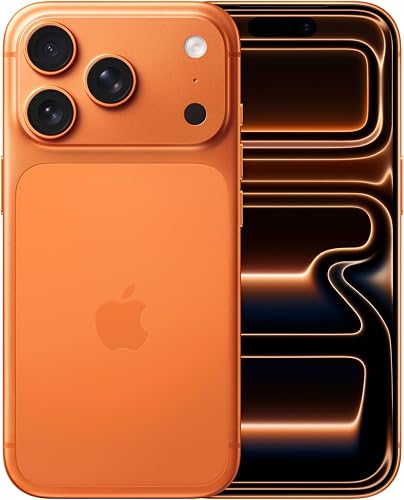
The frame is the change you can feel. Apple describes iPhone 17 Pro as a brushed 7000-series aluminum unibody with a vapor chamber laser-welded inside, Ceramic Shield 2 on the front and Ceramic Shield on the back. It measures 150.0 × 71.9 × 8.75 mm, weighs 206 grams and comes in Silver, Cosmic Orange and Deep Blue. iPhone 16 Pro is titanium with Ceramic Shield on the front and a textured matte glass back, 149.6 × 71.5 × 8.25 mm and 199 grams, in Black, White, Natural and Desert Titanium. If titanium is why you bought a 16 Pro, the 17 Pro doesn’t continue it. Water resistance is unchanged at IP68, 6 meters for up to 30 minutes.
Chip, radios and SIM
iPhone 17 Pro runs A19 Pro with a 6-core GPU and Neural Accelerators; iPhone 16 Pro runs A18 Pro with a 6-core GPU. iPhone 17 Pro also has Apple’s N1 networking chip, Wi-Fi 7 (802.11be) and Bluetooth 6, against Wi-Fi 7 and Bluetooth 5.3 on iPhone 16 Pro. Both have dual-frequency GPS, ultra-wideband and the same satellite safety features, with the two-year satellite offer that dates from iPhone 14, so check the current plan. Neither comes with a promised number of years of updates.
Used buyers should check the model: A3256 or A3257 means iPhone 17 Pro, and A3083 or A3084 means iPhone 16 Pro. iPhone 17 Pro uses dual eSIM and doesn’t take a physical SIM, US models included. iPhone 16 Pro is also eSIM-only, though Apple shows a SIM tray on phones bought outside the US.
What they cost
iPhone 17 Pro launched at $1,099 in the US on 9 September 2025, starting at 256GB, then 512GB and 1TB, which Apple described as doubling the entry storage. There’s no 128GB model, and no 2TB iPhone 17 Pro. iPhone 16 Pro launched at $999 on 9 September 2024 in 128GB, 256GB, 512GB and 1TB. That $100 gap compares two dated starting prices at different storage sizes, and both are older models now, so used and refurbished prices are what count. Check Apple and the seller before you buy.
Frequently asked questions
Should an iPhone 16 Pro owner upgrade to iPhone 17 Pro?
Only if you'll use what changed: a 3,000-nit outdoor peak, up to 33 hours of video playback against 27, faster wired and Qi2 charging, the 48MP telephoto and the 18MP Center Stage front camera. Camera Control, USB-C and the 6.3-inch ProMotion screen are already yours, and iPhone 18 Pro is now Apple's current Pro.
Did the 6.3-inch screen's resolution change?
No. Both are 2622 by 1206 at 460 pixels per inch, with ProMotion up to 120Hz, Dynamic Island and an always-on display. The outdoor peak is what moved: 3,000 nits on iPhone 17 Pro against 2,000 on iPhone 16 Pro.
Is iPhone 17 Pro's telephoto simply more zoom?
No. It's a 48MP lens at 100 mm and f/2.8, which Apple calls 4x, plus a 12MP optical-quality 8x crop at 200 mm. iPhone 16 Pro's dedicated telephoto is the longer lens: 12MP at 120 mm and f/2.8, a true 5x.
Do both already have USB-C and Camera Control?
Yes. Both have USB-C, an Action button and Camera Control, so none of them is a reason to leave iPhone 16 Pro. Both also run USB 3 at up to 10Gb/s, which needs a USB 3 cable.
Does Apple say how much RAM or battery capacity they have?
No. Apple gives neither figure for either phone, and iPhone 17 Pro has no audio-playback rating either. What you get are playback ratings: up to 33 hours of video and 30 streamed on iPhone 17 Pro, against 27 and 22 on iPhone 16 Pro, which is also rated for 85 hours of audio.
Sources
- Apple — iPhone 17 Pro tech specs — accessed 2026-09-19
- Apple Newsroom — iPhone 17 Pro, 9 September 2025 — accessed 2026-09-19
- Apple — iPhone 16 Pro tech specs — accessed 2026-09-19
- Apple Newsroom — iPhone 16 Pro, 9 September 2024 — accessed 2026-09-19