Smart glasses comparison · Maker specs
VITURE Luma vs VITURE Luma Pro

Quick Answer
Buy VITURE Luma at $399 over the $499 VITURE Luma Pro: same 1200p resolution and 1,000-nit rating, a lighter 77-gram frame and a stronger −6.0D myopia dial. Pro adds a slightly bigger 152-inch picture, HARMAN speakers, a magnetic cable and a Large size, but its dial stops at −4.0D. Neither has cameras or 6DoF.
The verdict
Buy VITURE Luma unless VITURE Luma Pro's slightly bigger screen, HARMAN audio and magnetic cable are worth $100 to you and your prescription stays within −4.0D.
Why: Resolution, refresh and brightness match: 1200p Sony micro-OLED, up to 120Hz and up to 1,000 nits on both, with the same electrochromic dimming and no cameras or 6DoF. Pro's picture is 152 inches at 4 meters across 52 degrees, against 146 and 50, and it adds HARMAN AudioEFX, RGB frame lighting and a Large size. Luma is lighter at 77 grams, against 79 or 81 for Pro, and its dial reaches −6.0D instead of −4.0D.
Buy VITURE Luma if
You're nearsighted beyond −4.0D, you want the lightest Luma, or you'd rather spend $399 and use a plain USB-C cable.
Buy VITURE Luma Pro if
Your prescription is within −4.0D and you want a slightly bigger picture, HARMAN-tuned speakers and the magnetic cable, or your eyes need the Large frame.
Luma is the entry point to VITURE’s Luma range and Luma Pro the all-round model, with the camera-equipped Luma Ultra above both. Between these two, the extra $100 changes the screen size, the speakers, the cable and the frame sizes, and it gives back some myopia correction.
Specs compared
| Spec | VITURE Luma | VITURE Luma Pro |
|---|---|---|
| Price | $399 | $499 |
| Virtual screen | 146 inches at 4 meters | 152 inches at 4 meters |
| Field of view | 50 degrees | 52 degrees |
| Display | 1200p Sony micro-OLED, up to 120Hz, up to 1,000 nits | Same |
| Myopia dial | To −6.0D | To −4.0D |
| Weight | 77 g | 79 g Regular, 81 g Large (VITURE Academy) |
| Frame sizes | Regular only, 56–72mm | Regular 64.0 ± 6.0mm; Large 68.0 ± 6.0mm |
| Speakers | AAC spatial sound, nine volume levels | HARMAN AudioEFX, nine volume levels |
| Cable | 1.2m USB-C | 1.2m USB-C to magnetic pogo |
| Frame lighting | None claimed | Dynamic RGB lighting |
| Dimming | Electrochromic, 0.5–40% transmission | Same |
| Head tracking | 3DoF in SpaceWalker; no 6DoF | Same |
| Cameras | None | No user-facing camera; privacy sticker in the box |
| Battery | None; powered by the host | Same |
| Water resistance | Not published | Not published |
The cheaper pair has the stronger dial
You’d expect the $499 model to correct more. It’s the other way round: Luma’s built-in adjustment goes to −6.0D, the strongest in the Luma series, and Luma Pro’s stops at −4.0D. Both have axis adjustment and an SGS A+ eye-care mark. If you’re past −4.0D and want to skip prescription inserts, Luma is the one that covers you; inside −4.0D, the dial is no reason to pass on Pro.
Both dials are for nearsightedness, and VITURE lists no correction for farsightedness on either. VITURE also warns that the dials can interfere with 3DoF tracking. Each pair has wear detection and three nose pads, and VITURE recommends sessions of 3 to 4 hours.
Pro’s picture is a little bigger
VITURE sizes Luma Pro’s picture at 152 inches from a simulated 4 meters, 52 degrees across, against 146 inches and 50 degrees on Luma. Six inches and two degrees is a real step, if not a dramatic one. The rest of the display doesn’t change: 1200p Sony micro-OLED at up to 120Hz and 1,000 nits on both.
Sound, cable and lights
Luma’s speakers use AAC spatial sound; Pro’s carry the HARMAN AudioEFX name. Beyond that VITURE gives both the same audio specs, a 250Hz fundamental give or take 50 and nine volume levels, and says you can listen without earbuds. If sound is why you’re comparing, Pro is the pair with a named tuning.
The cable is the difference you’ll handle every day. Luma takes a direct USB-C cable; Pro uses USB-C to a magnetic pogo connector, and VITURE counts the connector among the defining differences between the two. Both cables are 1.2 meters. If you swap devices all day, the magnet is handier; if you’d rather avoid a proprietary plug, Luma’s ordinary cable is the simpler choice.
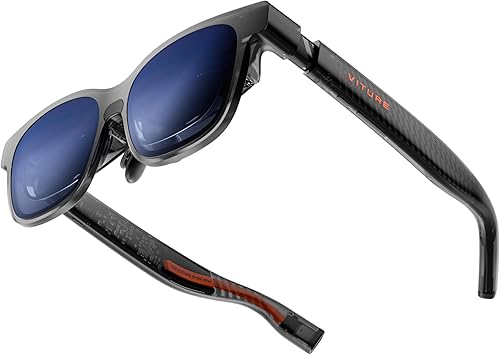
Pro’s matte translucent frame adds dynamic RGB lighting, which VITURE calls a first on XR glasses; Luma has a translucent frame with flexible arms. The lights are for looks and don’t change the picture.
Fit and weight
Luma comes in one size, Regular, for an interpupillary distance of 56 to 72mm, so there’s nothing to choose. Pro has two: a Regular frame centered on 64.0mm, plus or minus 6.0, which reaches 70, and a Large one centered on 68.0mm that reaches 74. VITURE’s advice for anyone who falls in both ranges is to choose by the nearer center, 64 or 68. Luma’s single frame reaches lower than either Pro frame, so very narrow-set eyes may only fit Luma, while only Pro’s Large goes past 72.
Luma weighs 77 grams, which VITURE says makes it the lightest Luma. Pro’s US page gives no weight, but VITURE Academy lists 79 grams for Regular and 81 for Large. Two grams is small next to the differences in cable and sound.
What neither one does
Neither has a camera or 6DoF. Both get 3DoF through SpaceWalker (VITURE adds a note about magnetometer drift on Pro), and a VITURE neckband has a lower resolution ceiling than the glasses themselves. On an iPhone, the spatial features need an adapter or dock, and whatever you plug into has to send video over USB-C; a charge-only port won’t show a picture. Neither has a battery, so the case in the box is just a case.
Price
Luma costs $399 and Luma Pro $499 at viture.com; VITURE covers US shipping on both and gives you 30 days to return them. Those prices can move, so check the store when you’re ready to order.
Luma ships with nose pads, a 1.2-meter USB-C cable, a case, a hair-friendly cover, a cleaning cloth, a quick start guide and a safety guide. In Pro’s box the cable is the magnetic one, and there’s a privacy sticker as well.
Skip both if you need 6DoF or a camera (that’s Luma Ultra, which comes in Regular only), if you’d rather have VITURE Pro 2’s UltraClarity optics at $299 and 63 grams, or if you want a camera and an assistant in everyday glasses. Both also need a phone, computer or console feeding them the whole time.
Frequently asked questions
Which Luma has the stronger myopia dial?
VITURE Luma, the $399 model. It corrects to −6.0D, which VITURE says is the most in the Luma series, while Luma Pro stops at −4.0D. If your prescription falls between the two, the cheaper pair is the only one that covers it without inserts.
Is Luma Pro just a brighter Luma?
No. Both are rated at up to 1,000 nits, with 1200p panels and refresh rates up to 120Hz. Pro changes the picture size (152 inches against 146 at 4 meters, and 52 degrees against 50), the speakers (HARMAN instead of AAC) and the cable (magnetic instead of plain USB-C).
Does either pair have a camera or 6DoF?
No. VITURE lists the camera and 6DoF as unsupported on Luma, and Luma Pro has neither; both track in 3DoF through SpaceWalker. Pro's box includes a camera privacy sticker, but there's no user-facing camera to cover. The Luma with RGB and depth cameras is Luma Ultra.
How heavy is Luma Pro?
79 grams in Regular and 81 in Large, according to VITURE Academy. Luma weighs 77 grams, which VITURE says makes it the lightest Luma.
Sources
- VITURE — Luma product page — accessed 2026-09-22
- VITURE — Luma Pro product page — accessed 2026-09-22