Fitness watches comparison · Maker specs
Garmin fēnix 9 vs Garmin fēnix 8
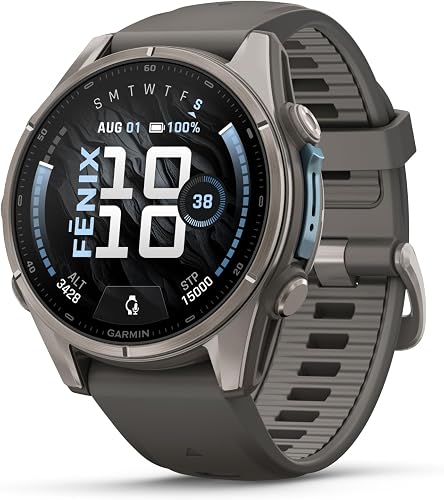

Quick Answer
Buy the 47mm Garmin fēnix 9 if you're buying new: at the same $999.99 the fēnix 8 range started at, it adds 64GB for maps and new stamina tools. Keep the 47mm Garmin fēnix 8 if you already have one: it's rated for the same 16 days as a smartwatch and has an LED flashlight the base fēnix 9 drops. Neither includes inReach.
The verdict
Buy Garmin fēnix 9 for maps, music and coaching; keep Garmin fēnix 8, or pick one up at a real discount, if the flashlight matters more to you than 64GB.
Why: Battery life barely moved: both 47mm AMOLED models are rated for up to 16 days as a smartwatch and 81 hours in Max Battery GPS, both dive to 40 meters, and inReach is a Pro feature with a plan in either generation. fēnix 9 adds 64GB with room for twice the maps, a faster map engine, sapphire and a titanium bezel as standard, and stamina tools. fēnix 8 has the LED flashlight with red and strobe modes, which the base fēnix 9 drops.
Buy Garmin fēnix 9 if
You're buying a 47mm fēnix new and want room for more maps and music, or you'll use stamina zones, Garmin Epic and the rucking tools.
Buy Garmin fēnix 8 if
You already own one and it still does the job, you rely on the red-light flashlight, or you find one well below the fēnix 9's $999.99.
Garmin announced the fēnix 8 on 27 August 2024 and the fēnix 9 on 25 August 2026, almost exactly two years apart. Both lines come in 43mm, 47mm and 51mm sizes and in Solar and Pro versions, each with its own battery figures; the matchup that follows is 47mm AMOLED against 47mm AMOLED.
What changed, side by side
| Spec | Garmin fēnix 9 (47mm AMOLED) | Garmin fēnix 8 (47mm AMOLED) |
|---|---|---|
| Announced | 25 August 2026 | 27 August 2024 |
| Lens and bezel | Sapphire; titanium bezel | Sapphire and titanium bezel optional |
| Brightness | “Twice as bright” as its predecessor | “Bright AMOLED”; no nit rating |
| Resolution, weight, thickness | Not published | Not published |
| Storage | 64GB | Not published |
| Smartwatch | Up to 16 days | Up to 16 days with gesture; 7 days always-on |
| Low-power watch mode | Up to 24 days | Up to 23 days battery saver |
| GPS | Up to 30 hours activity | 47 hours GPS-only; 35 hours multi-band |
| GPS with music | Up to 12 hours | Up to 10 hours |
| Max Battery GPS | Up to 81 hours | Up to 81 hours |
| Expedition | Up to 18 days | Up to 17 days |
| LED flashlight | No; Pro only | Yes, with red light and strobe |
| inReach | No; Pro only | No; Pro only |
| Phone | iPhone or Android (Garmin Connect) | iPhone or Android (Garmin Connect) |
| Water | 10 ATM; EN 13319 to 40m | 10 ATM; 4 ATM dive; EN 13319 to 40m |
| US price | $999.99 for the 47mm | Series from $999.99 |
Twice the maps
The fēnix 9 is the storage upgrade. Garmin gives it 64GB and says that holds twice as many maps as fēnix 8, plus up to 7,000 songs. Garmin also says the new map engine has 50 percent more RAM than the fēnix 8’s, pans up to 30 percent faster and adds a perspective view, and the maps are routable.
On the fēnix 8, maps depend on the lens: sapphire models come with TopoActive maps, other versions have to download them, and Outdoor Maps+ is a subscription. Round-trip routing and NextFork were part of its 2024 feature list.
The flashlight moved to the Pro
Every fēnix 8 in Garmin’s 2024 lineup has an LED flashlight with variable intensity, a red light and a strobe. The base fēnix 9 doesn’t have one: Garmin put the integrated LED flashlight, now with a green night-vision mode, on fēnix 9 Pro. If you use the light for night starts or around camp, it’s the clearest reason to keep a fēnix 8.
New training tools
Most of what’s new on the fēnix 9 is coaching. Stamina zones and a stamina curve show how your endurance changes as your training history builds. Garmin Epic gathers multi-day, multi-week or multi-month activities into one story in Garmin Connect, with health data and photos. Rucking lets you change pack weight during an activity, with targets up to 100 kilograms and GORUCK workouts, and indoor rowing shows VO2 max and a power curve if your rower has a power meter; without one, the curve isn’t available.
The fēnix 8 brought training readiness, endurance and hill scores, PacePro, ClimbPro and strength plans of about four to six weeks, plus animated exercises for strength, cardio, yoga and HIIT, and apnea and scuba activities. Those carry on in Garmin Connect; they just weren’t what Garmin highlighted for 2026.
Battery: the same 16 days, in different modes
Both 47mm models are rated for up to 16 days as a smartwatch and 81 hours in Max Battery GPS. Past that, Garmin rates them in different modes, so not every figure lines up:
| Mode | Garmin fēnix 9 (47mm AMOLED) | Garmin fēnix 8 (47mm AMOLED) |
|---|---|---|
| Smartwatch | Up to 16 days | Up to 16 days with gesture; 7 days always-on |
| Low-power or battery saver | Up to 24 days | Up to 23 days |
| GPS activity, Normal or Balanced | Up to 30 hours | Not published |
| GPS-only | Not published | Up to 47 hours; 37 always-on |
| GPS with music | Up to 12 hours | Up to 10 hours |
| Max Battery GPS | Up to 81 hours | Up to 81 hours |
| Expedition | Up to 18 days | Up to 17 days |
The fēnix 9 adds Extended and Max Accuracy GPS modes, rated for 37 and 25 hours. The fēnix 8 splits its GPS figures by satellite setting instead: 38 hours with all systems and 35 with all systems plus multi-band, or 30 and 28 with the screen always on, and Garmin mentions SatIQ alongside the multi-band figures. Always-on doesn’t apply in its battery saver mode.
If you keep the screen on, note that Garmin gives the fēnix 9 no separate always-on figure next to its 16 days, so the fēnix 8’s 7 days is the only always-on rating you’ll find. Garmin’s headline of up to 29 days is for the largest fēnix 9, not the 47mm, and Pro Solar models go further, with solar figures that depend on hours in 50,000-lux light.
Screen and build
Garmin says the fēnix 9’s AMOLED is twice as bright as its predecessor, and it calls the fēnix 8’s a bright AMOLED. The up-to-3,000-nit screen is fēnix 9 Pro’s.
The base fēnix 9 comes with a scratch-resistant sapphire lens and a titanium bezel; Garmin’s first titanium watch case is on fēnix 9 Pro. On the fēnix 8, sapphire and a titanium bezel were options. Leakproof metal buttons arrived with the fēnix 8 and carry over to the fēnix 9.
Diving, calls, health and the rest
Both generations carry EN 13319 dive certification to 40 meters. The fēnix 8 is rated 10 ATM with a 4 ATM dive rating, reads depth from 0 to 40 meters at 0.1-meter resolution, runs the Bühlmann ZHL-16C decompression model and works underwater from 0 to 40 degrees Celsius. The fēnix 9 matches the depth sensor, decompression model and temperature range, and Garmin calls its buttons dive-rated to 40 meters. Garmin describes the fēnix 8 as tested to US military standards for thermal, shock and water resistance.
Both measure heart rate at the wrist and track sleep in Garmin Connect, where the fēnix 9 gets a sleep score. Garmin listed more extras for the fēnix 8:
- Calls: a speaker and microphone for calls while paired, and some voice commands that work without the phone in your hand.
- ECG: an app in some regions for ages 22 and older; Garmin lists where at garmin.com/ECG.
- Pulse Ox: a wrist reading that Garmin says isn’t a medical device.
- Sleep: advanced sleep monitoring with nap detection, a morning report that includes HRV Status, and Body Battery.
Garmin’s fēnix 9 announcement repeats none of those, or the fēnix 8’s military-standard testing, so if one matters to you, confirm it on the fēnix 9 you’re considering. Neither announcement names a skin-temperature sensor.
Both use Garmin Connect on iPhone or Android, and neither is an Apple Watch or a Wear OS watch. Both pay with Garmin Pay; on the fēnix 9 it holds up to 10 cards behind a passcode, with a 24-hour session while the watch stays on your wrist. Both take QuickFit bands, and the fēnix 9 adds ComfortFit split-weave fabric bands as an accessory; confirm the 22mm QuickFit fit on the exact model before you buy a strap from another watch.
inReach, LTE, satellite voice and text, SOS, Garmin Locate and satellite weather are select fēnix 9 Pro features with a plan, and the fēnix 8’s LTE LiveTrack figures belong to its Pro too. Moving from a base fēnix 8 to a base fēnix 9 doesn’t add a satellite radio.
Price
The 47mm fēnix 9 is $999.99 at garmin.com, where 47mm finishes include titanium with pebble gray silicone and carbon gray DLC titanium with black silicone; availability varies by finish. fēnix 9 Pro, the model with inReach and LTE, starts at $1,099.99. Garmin’s fēnix 8 range started at $999.99 in 2024, and the lens (sapphire or standard) and bezel (steel or titanium) changed the price. A discounted 47mm fēnix 8 with sapphire and the flashlight can be the better buy if you don’t need 64GB or stamina zones; if maps and the new coaching are why you’re replacing the 2024 watch, get the fēnix 9. Prices move, so check garmin.com before you buy.
Frequently asked questions
Does Garmin give a brightness rating for these 47mm watches?
No. Garmin says the fēnix 9's AMOLED is twice as bright as its predecessor and calls the fēnix 8's a bright AMOLED, but it gives no nit figure for either base model. The up-to-3,000-nit rating belongs to fēnix 9 Pro.
How much map storage does the 47mm fēnix 9 add?
It has 64GB, which Garmin says holds twice as many maps as fēnix 8 and up to 7,000 songs. Garmin doesn't give the fēnix 8's storage in gigabytes, so there's no exact difference to work out.
Is the LED flashlight on the base fēnix 9?
No. The flashlight with red and strobe modes came on every fēnix 8 in Garmin's 2024 lineup. For fēnix 9, Garmin moved the integrated LED flashlight, now with a green night-vision mode, to fēnix 9 Pro.
What did each 47mm model cost at launch?
The same $999.99 starting point. The 47mm fēnix 9 is $999.99 at garmin.com, and fēnix 9 Pro starts higher, at $1,099.99. Garmin's fēnix 8 range started at $999.99 on 27 August 2024.
Sources
- Garmin fēnix 9 product page — accessed 2026-09-22
- Garmin Newsroom — fēnix 9 and fēnix 9 Pro, 25 August 2026 — accessed 2026-09-22
- Garmin fēnix 8 product page — accessed 2026-09-22
- Garmin Newsroom — fēnix 8 series, 27 August 2024 — accessed 2026-09-22