Fitness rings comparison · Maker specs
Samsung Galaxy Ring vs Ultrahuman Ring AIR

Quick Answer
Buy Samsung Galaxy Ring ($399.99) if you have a Galaxy phone, which it requires: it lasts 6 or 7 days a charge and comes with a charging case. Buy Ultrahuman Ring AIR ($349) for an iPhone or another Android phone; it's thinner, but lasts 4 to 6 days and charges on an open pad. Neither asks for a membership. In the US, Ultrahuman's AIR page now opens Ring PRO, so AIR may be hard to find.
The verdict
Buy Samsung Galaxy Ring if you carry a Galaxy phone and want the case and the longer battery; buy Ultrahuman Ring AIR for any other phone, or for a slimmer, cheaper ring if you can find one.
Why: Both are titanium, both start at size 5 and both are rated for water down to 100 meters. Samsung adds Energy Score, snore detection and a case that can refill the ring up to 1.6 times. Ultrahuman's ring pairs with iPhone as well as Android and is 2.4 or 2.45 millimeters thick, against 2.6 for Galaxy Ring.
Buy Samsung Galaxy Ring if
Your phone is a Samsung Galaxy, you'd like a case that recharges the ring on the go, or you wear a size 15, which AIR doesn't come in.
Buy Ultrahuman Ring AIR if
You're on an iPhone or an Android phone from another brand, you want the slimmer and cheaper ring, and a charging pad every 4 to 6 days doesn't bother you.
Ring AIR is Ultrahuman’s second-generation ring, which its 11 June 2024 FAQ pitched as R1 made thinner and lighter, with the same features and battery. Galaxy Ring comes at the job from the phone side: it’s Samsung’s ring for people who already keep their health data in Samsung Health.
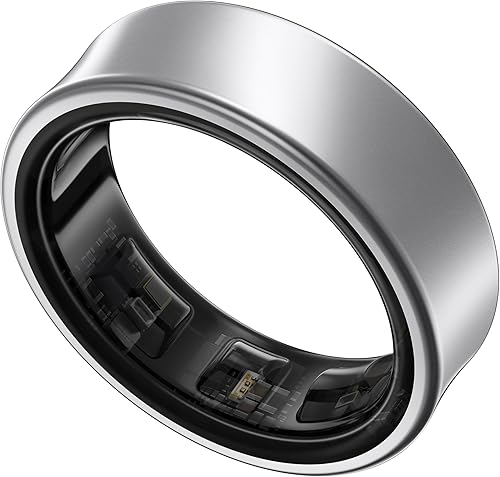
Galaxy Ring and AIR side by side
| Spec | Samsung Galaxy Ring | Ultrahuman Ring AIR |
|---|---|---|
| US price | $399.99 | $349 on Ultrahuman’s PRO and AIR comparison |
| Phone | Samsung Galaxy phone with a Samsung account | iPhone or Android, through the Ultrahuman app |
| Membership | None | None for core data |
| Battery | Up to 6 or 7 days, by size | 4–6 days |
| Charging | In the included case, about 80 or 90 minutes | Open wireless pad, about 180 minutes from empty |
| Spare charge | Case refills the ring up to 1.6 times | No case |
| On-ring storage | Not published | 4 days |
| Sizes | 5–15 | 5–14 |
| Thickness | 2.6 mm | 2.45 mm (2024 FAQ); 2.4 mm (current comparison) |
| Width | 7 mm | Not published |
| Weight | 2.3–3.2 g, by size | 2.4 g |
| Material | Titanium | Titanium with PVD and a plastic inner; tungsten-carbide coating in the 2024 FAQ |
| Water | 10 ATM and IP68 | 100 m (328 ft) |
| Sensors | Optical heart rate, skin temperature, accelerometer | PPG, temperature, 6-axis motion sensor |
| Finishes | Titanium Black, Silver, Gold | Raw Titanium, Aster Black, Matte Grey, Bionic Gold, Space Silver |
Your phone decides most of it
Galaxy Ring runs through Samsung Health and Galaxy Wearable, and only on a Galaxy phone. What you get for that lock-in is Samsung’s own tracking: Energy Score, which rolls your sleep, activity and heart rate into one number; sleep analysis from heart rate, blood oxygen and skin temperature; and snore detection. With a phone on One UI 6.1.1 or higher, a double pinch dismisses an alarm or takes a photo, unless a Galaxy Watch with gestures turned on is also paired, in which case the watch takes over. Samsung adds no membership on its US pages, but read its terms before you assume every feature stays free.
Ring AIR works with the Ultrahuman app on iPhone or Android, though Ultrahuman doesn’t list the minimum phone or OS versions. It tracks sleep and recovery with a PPG heart sensor, a temperature sensor and a 6-axis motion sensor on a single-core chip, and Ultrahuman says its ring features in the app match R1’s. It has no GPS. Ultrahuman’s current FAQ says core data carries no recurring fee; that line sits on the Ring PRO page, so confirm it wherever you buy AIR.
A charging case against an open pad
Samsung has described Galaxy Ring’s battery three ways. Its introduction to the ring says up to 7 days and about 80 minutes to charge, with an 18mAh cell in size 5 and 23.5mAh in size 13. Its charging guide lists 17, 18.5 and 22.5mAh batteries, gives sizes 5 to 11 up to 6 days and sizes 12 to 15 up to 7, and says a charge takes about 90 minutes. The fine print on its US store page gives 7 days only to sizes 12 and 13, and 6 to smaller sizes. Unless you wear a 12 or bigger, plan on 6 days.
Where Galaxy Ring pulls ahead is the case. It comes in the box, sized to your ring, and Samsung says a full case can recharge the ring to 100 percent up to 1.6 times; its marketing counts ring and case together as up to 14 days away from a wall socket. If the ring ever runs completely flat, give it ten minutes on the charger before expecting a response.
AIR has no case. Ultrahuman rates it for 4 to 6 days, and it goes back on an open wireless pad for about 180 minutes from empty to full, so the pad travels with you. If you came to Ultrahuman for a 15-day battery, that’s Ring PRO, not AIR.
AIR is thinner, but not always lighter
Galaxy Ring is 2.6 millimeters thick and 7 millimeters wide. Ultrahuman puts AIR at 2.45 millimeters in the 2024 FAQ and 2.4 millimeters on its current comparison table, a 0.05-millimeter disagreement, and gives no width. Either figure makes AIR the slimmer ring.
Weight is closer than the pitch suggests. AIR’s single figure, 2.4 grams, sits inside Galaxy Ring’s range of 2.3 to 3.2 grams, so the smallest Galaxy Ring is a hair lighter and the largest is nearly a gram heavier.
Galaxy Ring runs from size 5 to 15 and AIR from 5 to 14, so a size 15 means Samsung. Samsung says to wear a sample from its sizing kit for more than 24 hours; its sizing video shows samples from 5 to 13, while its sizing article says the kit includes every available size. Ultrahuman’s sizes don’t line up with Oura’s, but an R1 sizing kit works for AIR.
Both rings are titanium. Galaxy Ring comes in Titanium Black, Silver and Gold. AIR has a PVD finish and a hypoallergenic plastic inner on Ultrahuman’s current comparison, while the 2024 FAQ describes a tungsten-carbide coating instead, and it comes in Raw Titanium, Aster Black, Matte Grey, Bionic Gold and Space Silver.
Water, the gym and health limits
Both are rated for water down to 100 meters, but the details differ. Samsung rates Galaxy Ring at 10 ATM and IP68 and spells those out as up to 100 meters for 10 minutes and up to 6 feet for 30 minutes; rinse it after salt water or chlorine. Ultrahuman rates AIR to 100 meters (328 feet), names swimming, showering and scuba diving, and asks you not to keep it underwater for more than 30 minutes at a stretch. Only Ultrahuman mentions scuba.
Ultrahuman also advises against wearing AIR for heavy weight training, because of contact with metal. Galaxy Ring’s cycle tracking isn’t meant for contraception or for anyone under 18. If you need a ring sold as a medical device, skip both.
Price and stock
On the morning of 19 September 2026, Samsung’s US store listed Galaxy Ring at $399.99 with Silver still available; by evening, Black, Gold and Silver all showed out of stock. The $150 instant trade-in credit on the page that evening is a promotion, not the ring’s price.
AIR’s $349 comes from the PRO and AIR comparison on Ultrahuman’s US Ring PRO page that same day. Ultrahuman’s own US page for AIR was opening Ring PRO instead, so a new AIR may take some hunting in the US. Stock and prices move, so check both stores before you buy.
Frequently asked questions
Does Samsung Galaxy Ring work without a Galaxy phone?
No. In the US, Galaxy Ring has to be set up with a Samsung account on a Samsung Galaxy phone, and your health data goes to Samsung Cloud. An iPhone or another brand of Android phone won't do. Ultrahuman Ring AIR pairs with the Ultrahuman app on iPhone or Android.
How much does Ultrahuman Ring AIR weigh?
2.4 grams, the one figure Ultrahuman gives in both its 2024 FAQ and its current comparison table. Galaxy Ring's weight depends on the size: 2.3 to 3.2 grams in Samsung's US figures, while Samsung UK gives 3.3 grams for a size 15.
Does Ring AIR come with a travel case?
No. AIR charges on an open wireless pad, about 180 minutes from empty to full, so there's no case carrying spare charge. Galaxy Ring's case comes in the box, made for your size, and Samsung says a full case can recharge the ring to 100 percent up to 1.6 times.
How many days of data does each ring store?
AIR stores 4 days of data on its internal flash, so it can go that long without syncing to your phone. Samsung doesn't say how much Galaxy Ring holds. Battery life is a separate figure: 4 to 6 days for AIR, and 6 or 7 for Galaxy Ring, depending on size.
Sources
- Samsung US — Galaxy Ring — accessed 2026-09-22
- Samsung US support — Introducing the Samsung Galaxy Ring — accessed 2026-09-22
- Samsung US support — How to charge the Galaxy Ring — accessed 2026-09-22
- Ultrahuman — Ring AIR FAQs — accessed 2026-09-22
- Ultrahuman — Ring PRO US store, with the PRO and AIR comparison — accessed 2026-09-22