Earbuds comparison · Maker specs
Bose QuietComfort Ultra Earbuds (2nd Gen) vs Sony WF-1000XM6
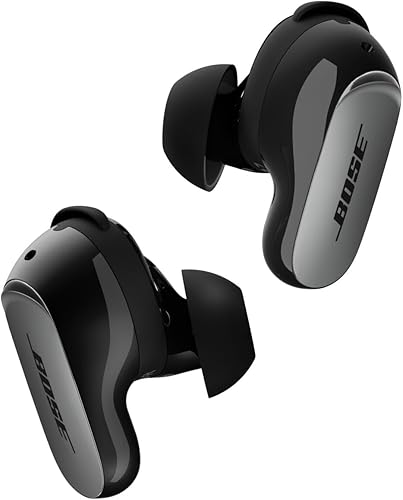

Quick Answer
Buy Sony WF-1000XM6 at $329.99 for the longer battery and LDAC: 8 hours with noise cancelling on, against Bose's 6. Buy Bose QuietComfort Ultra Earbuds (2nd Gen) at $299 if your phone supports aptX Adaptive or you want Immersive Audio. On an iPhone both use AAC, so it comes down to battery against price.
The verdict
Get Sony WF-1000XM6 for the longer battery and LDAC; get Bose QuietComfort Ultra Earbuds (2nd Gen) if your phone does aptX Adaptive, you want Immersive Audio, or the lower price matters most.
Why: Both are sealed earbuds with IPX4 buds, Bluetooth 5.3, multipoint for two devices and cases that charge on a Qi pad, and neither company gives a decibel figure for its noise cancelling. They split on codecs and battery: Bose has aptX Adaptive, Sony has LDAC and LC3, and both use AAC with an iPhone. Sony rates its buds for 8 hours with noise cancelling on; the most Bose quotes is 6 hours.
Buy Bose QuietComfort Ultra Earbuds (2nd Gen) if
Your Android phone supports Snapdragon Sound and you want aptX Adaptive, you'll use Immersive Audio, or you want stability bands in the box and the $299 price.
Buy Sony WF-1000XM6 if
You're on Android and want LDAC, you want the most listening per charge and a rated talk time, or you'd like lighter buds and a smaller case.
Bose announced the second-generation QuietComfort Ultra Earbuds on 12 June 2025, and Sony followed eight months later, on 12 February 2026, with WF-1000XM6, the newest pair in its 1000X line. They go after quiet in different ways: Sony leans on processing, with a faster chip and a new driver, and Bose on fitting the buds to you, with CustomTune and stability bands.
Spec by spec
| Spec | Bose QuietComfort Ultra Earbuds (2nd Gen) | Sony WF-1000XM6 |
|---|---|---|
| Announced | 12 June 2025 | 12 February 2026 |
| US price | $299 at launch | $329.99 list |
| Codecs | SBC, AAC, aptX Adaptive | SBC, AAC, LDAC, LC3 |
| Music per charge | Up to 6 hours; 4 with Immersive Audio | Up to 8 hours with noise cancelling on; 12 off |
| With the case | Three extra charges; 18 hours in a full case | Up to 24 hours |
| Talk time | Not published | Up to 5 hours with noise cancelling on; 5.5 off |
| Quick charge | 20 minutes for about 2 hours | Not published |
| Full charge | Buds about 2 hours; case about 3 hours | Buds about 1.5 hours; case about 2 hours |
| Processor | Not named | QN3e with Integrated Processor V2 |
| Driver | Not published | 0.33 inch |
| Microphones | Eight, 4 per bud | Four per bud, plus a bone-conduction sensor |
| Spatial audio | Immersive Audio | 360 Reality Audio on compatible Android phones |
| Water | Buds IPX4; case not water resistant | Buds IPX4; case not rated |
| Bluetooth | 5.3, multipoint, 30 ft range | 5.3, multipoint, 32.80 ft range |
| Wireless charging | Built into the case | Qi case; pad sold separately |
| One bud | 0.017 lb (0.016 lb on Bose’s US store) | About 0.23 oz with M tips |
| Case | 0.132 lb; 2.61 × 2.35 × 1.06 in | About 1.66 oz; 2.43 × 1.62 × 1.04 in |
| Fit kit | Tips S, M, L; stability bands 1, 2, 3; wax guard | Noise Isolation tips in four sizes |
| Colors | Black, White Smoke, limited Deep Plum | Platinum Silver, Black |
Your phone picks the codec
Bose supports SBC, AAC and aptX Adaptive. The aptX Adaptive link only works with a Snapdragon Sound phone; with anything else, the Bose pair falls back to AAC or SBC. Bose also supports Google Fast Pair for quick setup on Android.
Sony supports SBC, AAC, LDAC and LC3. LDAC needs Priority on Sound Quality switched on in Sony’s Sound Connect app and a phone that can play it. LC3 is the codec behind LE Audio, which Sony says the buds are ready for. On a supported Android phone, Sony’s buds also work with Gemini, including the “OK Google” hotword.
On an iPhone, both pairs connect over AAC, and neither adds LDAC or aptX Adaptive.
Battery: Sony lasts longer per charge
Sony rates WF-1000XM6 for up to 8 hours of music with noise cancelling on and 12 with it off. The most Bose quotes for the 2nd Gen is 6 hours with Immersive Audio off, and it drops to 4 with Immersive Audio on. So even with noise cancelling running, Sony’s buds go two hours longer than Bose’s best figure.
With the case, the totals come out level. Sony says up to 24 hours, which its European launch announcement splits into 8 in the buds and 16 from the case with noise cancelling on. Bose says the case holds three extra charges, or 18 hours when it’s charged to 100 percent; add the 6 in the buds and that’s 24 as well.
Bose rates a quick top-up, 20 minutes in the case for about 2 hours with Immersive Audio off; Sony doesn’t give a quick-charge figure for WF-1000XM6. A full charge takes about 2 hours for Bose’s buds and 3 for its case, against about 1.5 hours for Sony’s buds and 2 for its case over USB. Both cases also charge on a Qi wireless pad, which Sony says is sold separately.
Noise cancelling and sound: claims, not numbers
Sony says its HD Noise Cancelling Processor QN3e is three times faster than the processor in WF-1000XM5, and pairs it with Integrated Processor V2 and an Adaptive NC Optimizer. Sony Europe adds that the 0.33-inch driver is newly developed, with mixed materials in the dome and the edge, and claims 25 percent further noise reduction than WF-1000XM5.
On the Bose side, CustomTune uses a calibration tone to adapt the sound and the noise cancelling to your ear. Bose calls the 2nd Gen’s noise cancelling enhanced and adaptive, and says ActiveSense now steps more smoothly in Aware Mode, the setting that lets the outside world in.
Neither company backs any of this with a decibel figure, so the specs can’t tell you which pair is quieter. For spatial audio, Bose has Immersive Audio, which cuts the battery rating from 6 hours to 4. Sony has 360 Reality Audio on compatible Android phones.
Calls
Bose puts four microphones in each bud, eight in all, and calls its voice pickup SpeechClarity. It says some of that processing grew out of hearing-aid research, but that’s about calls: neither pair has a hearing-aid mode.
Sony Europe counts four microphones per bud, plus a bone-conduction sensor. Sony also rates calls at up to 5 hours with noise cancelling on and 5.5 with it off. Bose gives no talk time at all, so if you spend hours on the phone, Sony is the pair with a number behind it.
Weight, size and fit
Each Sony bud weighs about 0.23 ounces with medium tips, and the case is about 1.66 ounces and 2.43 by 1.62 by 1.04 inches. Bose measures in pounds, and its own bud figures disagree: 0.017 pounds in its support specs, 0.016 on its US store. Its case is 0.132 pounds and 2.61 by 2.35 by 1.06 inches, and each bud is 1.18 by 0.49 by 0.98 inches. Convert the pounds to ounces and Sony comes out lighter, bud and case, whichever Bose figure you use, and its case is smaller in every dimension.
Bose packs small, medium and large tips, stability bands in sizes 1, 2 and 3 to help the buds stay put, and a wax guard. Sony packs its Noise Isolation tips, in four sizes according to Sony Europe.
What they share
Both run Bluetooth 5.3 with multipoint, so two devices can stay connected, and Bose rates the range at 30 feet to Sony’s 32.80. Both charge over USB-C and set up through an app: the Bose app, where you can turn the touch controls off, and Sony’s Sound Connect, home to DSEE Extreme, Ambient Sound, Quick Attention and Speak-to-Chat. Neither has Find My or ultra-wideband for tracking down a lost bud.
Price
Bose launched the 2nd Gen at $299. Sony lists WF-1000XM6 at $329.99, about $30 more, though a 16 March 2026 snapshot of Sony’s US store showed it on sale at $299.99. When the two meet on price, Sony’s battery and LDAC cost nothing extra; when Bose is the one discounted, the gap widens. Bose comes in Black, White Smoke and a limited Deep Plum, Sony in Platinum Silver and Black. Prices move, so check Bose and Sony before you buy.
If an older pair at a discount is tempting, Sony WF-1000XM5 vs Sony WF-1000XM6 and Bose QuietComfort Ultra Earbuds vs Bose QuietComfort Ultra Earbuds (2nd Gen) cover what each newer pair adds.
Frequently asked questions
Which codecs will my phone actually use?
AAC on an iPhone, with either pair. On Android, the Bose pair adds aptX Adaptive if your phone supports Snapdragon Sound, and Sony adds LDAC and LC3. LDAC also needs Priority on Sound Quality switched on in Sony's Sound Connect app and a phone that can play it.
Which pair lasts longer on a charge?
Sony WF-1000XM6. Sony rates it for up to 8 hours with noise cancelling on and 12 with it off; Bose rates the 2nd Gen for up to 6 hours, or 4 with Immersive Audio on. Counting the case, they come out level: Sony says 24 hours, and Bose's case adds 18 to the 6 in the buds.
Is either charging case water resistant?
Neither is rated. Bose says the 2nd Gen's case isn't water resistant, and Sony gives the WF-1000XM6 case no water rating. Both rate the buds IPX4 against splashes, so it's the case you need to keep dry.
Do I need a Snapdragon phone for the Bose pair?
Only for aptX Adaptive, which Bose says needs a Snapdragon Sound phone. Without one, the Bose pair connects over AAC or SBC like any other, and multipoint for two devices has no such requirement.
Sources
- Bose — QuietComfort Ultra Earbuds (2nd Gen) product page — accessed 2026-09-22
- Bose support — QuietComfort Ultra Earbuds (2nd Gen) specifications — accessed 2026-09-22
- Bose press room — QuietComfort Ultra Earbuds (2nd Gen), 12 June 2025 — accessed 2026-09-22
- Sony — WF-1000XM6 specifications — accessed 2026-09-22
- Sony Electronics — WF-1000XM6/S product page — accessed 2026-09-22
- Sony Europe — WF-1000XM6 launch announcement, 12 February 2026 — accessed 2026-09-22